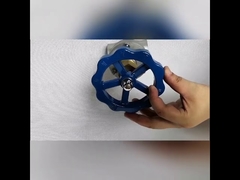
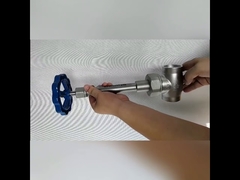
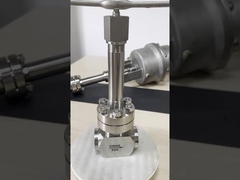
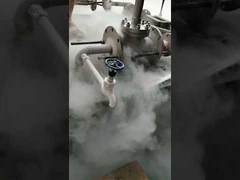
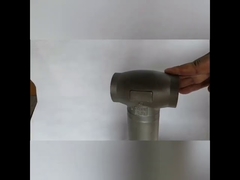
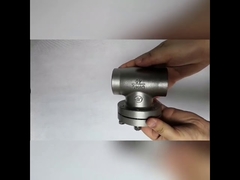
Brief: This short presentation tells the story behind the design and its intended use cases. Watch as we demonstrate the CNLN DJ61F-50P Cryogenic Globe Valve, showcasing its long stem design and PTFE seal in action. You'll see how this manual valve operates within extreme temperatures from -196°C to +80°C and handles pressures up to 5.0Mpa, making it ideal for LNG, LOX, and other cryogenic gas applications.
Related Product Features:
Designed for cryogenic applications with an operational temperature range from -196°C to +80°C.
Features a robust CF8/CF3 stainless steel valve body for superior durability and corrosion resistance.
Equipped with a PTFE seal ring ensuring reliable performance and leak-proof operation in low-temperature environments.
Manual operation with a long stem and blue handwheel for precise control and easy identification.
Handles high-pressure applications with a maximum working pressure of 5.0Mpa.
Available in multiple sizes from 3/8'' to 4'' to fit various pipeline requirements.
Suitable for controlling the flow of cryogenic liquids and gases like LNG, LOX, LIN, LAR, and CO2.
Model DJ61F-50P features threaded end connections for secure and straightforward installation.
FAQs:
What is the temperature range for the Cryogenic Globe Valve?
The Cryogenic Globe Valve is designed to operate effectively within a temperature range from -196°C to +80°C, making it suitable for extreme low-temperature applications.
What materials are used in the construction of the valve body?
The valve body is constructed from high-quality stainless steel, specifically CF8/CF3 grades (equivalent to SS304/SS316), ensuring durability and resistance to corrosion in cryogenic environments.
What is the main function of the Cryogenic Long Stem Globe Valve?
The primary function of this valve is to reliably start and stop the flow of low-temperature liquids and gases, controlling the inlet and outlet in systems handling LNG, LOX, and similar media.
What is the maximum pressure rating for this valve?
This Cryogenic Globe Valve has a maximum working pressure of 5.0Mpa, with an operational pressure range typically from 1.6Mpa to 5.0Mpa, ensuring safety in high-pressure scenarios.